![Grip-Vertical-Logo-Purple-1.png]](https://support.grip.events/hs-fs/hubfs/Grip-Vertical-Logo-Purple-1.png?width=23&height=34&name=Grip-Vertical-Logo-Purple-1.png)
Note: Slot Priorities is built directly into Grip’s MustMeet scheduler, alongside Preferences and Scoring & Schedules. You no longer need to, but still could, run MustMeet Legacy (H2H) to control the order meetings are booked into your timeslots, though note that setting timeslots in the Engage Admin Portal will not affect the legacy scheduler.
How it works
Grip’s scheduler uses a rule-based system instead of asking you to assign a priority number to every individual slot. This is because this scheduler supports locations with different start times, end times, lengths, and days — there's no single, uniform slot grid to number slot-by-slot.
Instead, you create rules that match slots by day, slot start time, and/or location, and assign each rule a priority. When you generate schedules, the scheduler works through your locations in priority order (and then from earliest to latest) - meetings booked at the start of that order naturally end up with the higher-scoring pairings.
In this article, we will cover both ways of scheduling.
⚠️ Important: Priority numbering:
- In MustMeet Legacy, 1 is the lowest priority and 100 is the highest.
- In Grip’s MustMeet Scheduler, rule-based Slot priorities system: priority 1 is the highest, and priority 100 is the lowest.
Double-check your numbering if you're used to the older system.
Configuring Slot priorities in Grip MustMeet Scheduler platform
Where to find it in Grip
Go to the Slot Priorities page. It sits between Preferences and Scoring & Schedules in the setup flow.
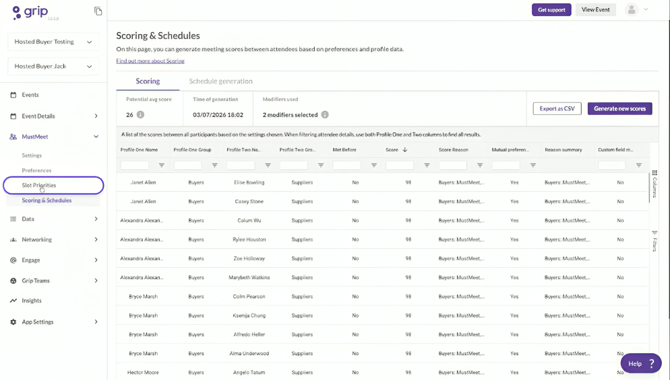
You can also get there mid-flow: if you're on the Generate Schedule step and haven't set your priorities yet, there's a link at the bottom of the page to open Slot Priorities in a new tab. Set your rules there, then come back to the original tab and generate schedules right away — you don't need to restart the flow.
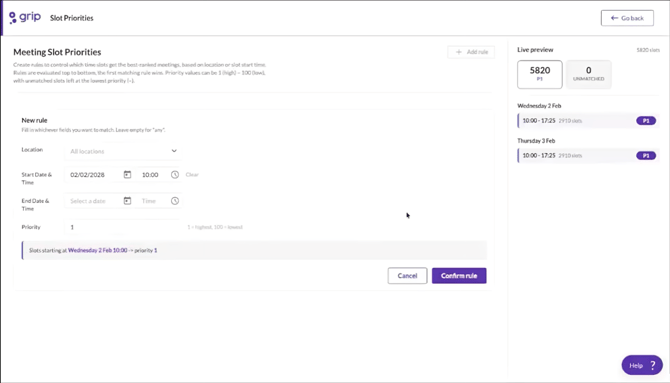
Create a location-based rule
You can also assign a priority to an entire meeting location, rather than a time range. This is useful if you want to give a specific group — for example, sponsors or attendees who've paid for a premium package — a better chance at higher-scoring meetings, regardless of when in the day those meetings land.
- On the Slot Priorities page, click Add Rule.
- Select a Location instead of a day/time range.
- Assign a priority number to that location.
- Click Save.
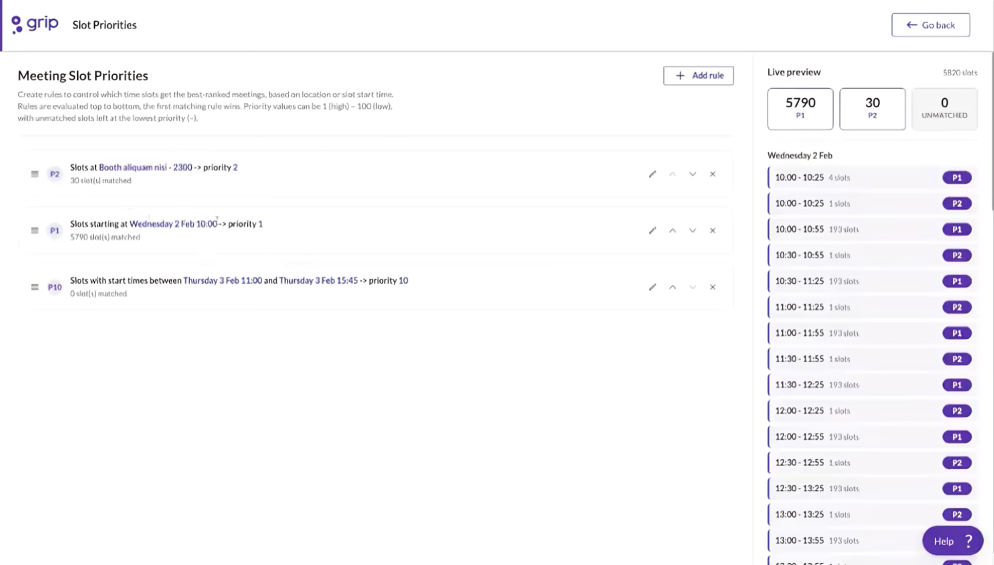
Reordering rules that overlap
Because rules can be based on time, location, or both, a single slot can end up covered by more than one rule: for example, a slot starting at 10:00 in a location that also has its own priority rule. When this happens, you need to tell the scheduler which rule to apply first.
Use the reorder option on the Slot Priorities page to set the order rules are processed in. The preview panel next to each rule updates as you reorder, so you can check the result before generating schedules.
Create a time-based rule
- On the Slot Priorities page, click Add Rule.
- Set a slot start time (and optionally an end time) and the day the rule should apply to — for example, "slots starting on Wednesday at 10:00" or "slots starting between 11:00 and 17:45 on Wednesday."
- Note that this rule is focused on the start time of the slot. This means that you set an ‘end time’ you are only including slots that start in between the start and end times, not slots that are totally encompassed within those times.
- Assign a priority number between 1 (highest) and 100 (lowest).
- Click Save. Each rule shows a preview of how many slots it currently matches, so you can confirm it's covering what you expect.
Repeat this to build up as many rules as you need - you can get as specific as you like across different days, times, and locations.
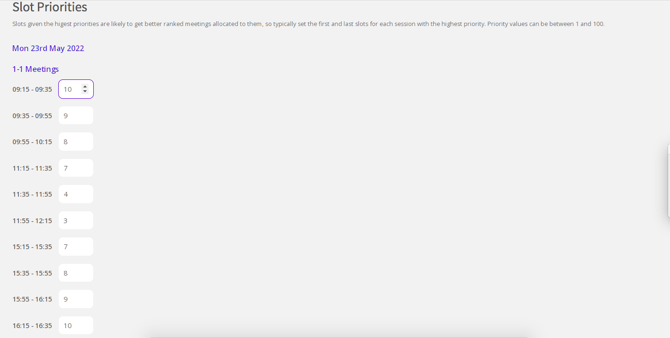
On the MustMeet Legacy Scheduler dashboard, you are able to set priorities for each timeslot in event. This controls the order in which the Scheduler creates meetings, starting with the highest scores and working downwards for each slot until it's full.
Configuring Slot priorities in MustMeet Legacy scheduler
1- Go to Edit Slot Priorities on MustMeet
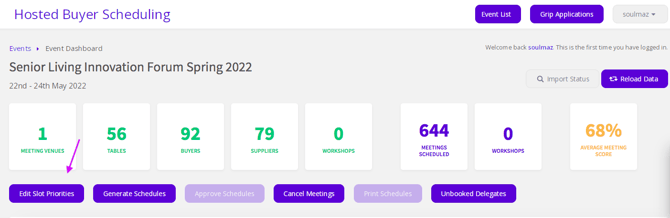
2 - Assign a number between 1 (lower priority) - 100 (higher priority)
FAQ:
Do I still need MustMeet Legacy (H2H) to set slot priorities?
No. Slot Priorities is part of the modern scheduler. You don't need to switch to Legacy for this step anymore.
Why did the priority numbering change from Legacy?
In Legacy, priority 100 was the highest and 1 was the lowest. In the new rule-based system, this is flipped: 1 is now the highest priority and 100 is the lowest. The change was made because most people intuitively expect "priority 1" to mean "the most important." Double-check your numbers if you're used to the Legacy scale.
Can I still use Slot Priorities if my locations have different slot lengths, start times, or run on different days?
Yes. Unlike the older legacy system, which required all slot times to be identical and evenly spaced, the new rule-based system is built to work across locations with different start times, end times, lengths, and days.
What happens if a slot matches more than one rule?
This is common — for example, a slot can fall within a time-based rule and also sit in a location that has its own priority rule. When rules overlap, you can reorder them on the Slot Priorities page to control which one applies first. The preview panel updates as you reorder, so you can check the effect before generating schedules.
Can I prioritize a specific location instead of a time of day?
Yes. Alongside time-based rules, you can assign a priority directly to an entire meeting location — useful if you want a sponsor's or premium-package holder's location to get first pick, regardless of when their meetings land in the day.
What if I forget to set my Slot Priorities before generating schedules?
You don't need to restart your flow. On the Generate Schedule step, there's a link to open Slot Priorities in a new tab. Set your rules there, then return to the original tab and generate schedules right away.
If you have already run the scheduler, you can simply re-run the scheduler again after setting Slot Priorities to regenerate according to the new rules.
Does the underlying scheduling logic change?
No. The scheduler still works through locations in priority order, and meetings booked at the start of that order get the highest-scoring pairings — same as Legacy. What's changed is how you assign priority (rules instead of a number on every slot), not how the schedule itself gets generated.